

The Science of Rolling: Why BJJ Is Emerging as a Trauma Therapy
Brazilian Jiu-Jitsu is usually described as a grappling martial art. Inside psychology and sports science, researchers are starting to study it for something else: its effect on trauma and mental health.
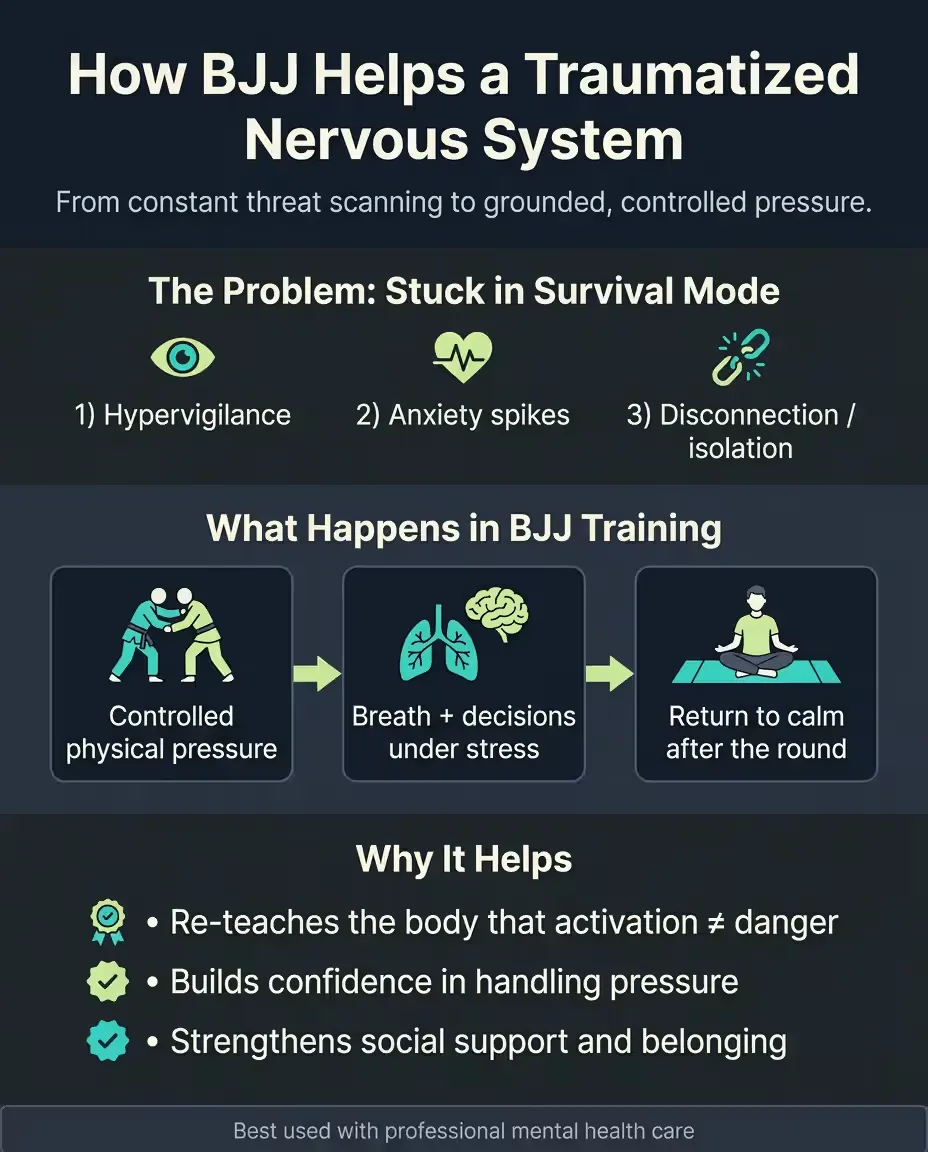
Trauma changes how the nervous system reacts to stress. Many people with PTSD (Post-Traumatic Stress Disorder) live in a constant state of hypervigilance. The brain interprets normal situations as threats. Traditional therapy focuses on processing memories and changing thought patterns.
Brazilian Jiu-Jitsu works differently. It engages the body first, in ways that overlap with nervous system training on the mats rather than only cognitive processing.
During training, practitioners experience controlled physical pressure, rapid problem solving, and close contact with a resisting partner. These situations activate the sympathetic nervous system - the same system responsible for fight-or-flight responses. The difference is that training takes place in a safe, rule-based environment where, at any moment, a practitioner can stop the exchange by tapping.
Because of this structure, psychologists and sports scientists increasingly discuss BJJ as a form of somatic stress exposure.
Research on BJJ and PTSD
Key scientific findings
Several academic studies have examined how Brazilian Jiu-Jitsu affects PTSD symptoms and psychological wellbeing.
A widely cited study by Willing et al. (2019), published in Military Medicine, followed U.S. service members and veterans with PTSD symptoms who completed a five-month BJJ training program.
Researchers observed:
- clinically meaningful reductions in PTSD symptoms
- lower depression scores
- reduced anxiety levels
The authors suggested that BJJ provides structured exposure to stress while teaching emotional regulation and resilience.
Another scoping review in The Sport Journal examined studies on Brazilian Jiu-Jitsu and mental and physical health among veterans and first responders. The review highlighted several mechanisms that may explain these improvements:
- controlled exposure to physical stress
- development of self-efficacy through skill mastery
- social bonding within training communities
- regulation of breathing and movement under pressure
These mechanisms overlap with principles used in exposure therapy, somatic therapy, and behavioral activation.
Qualitative work on BJJ and wellbeing further supports these findings. An inductive thematic analysis in Mental Health and Social Inclusion described how BJJ can build mental toughness, meaningful habits, and supportive social relationships that buffer against distress.
Why Grappling Affects the Nervous System
How trauma disrupts stress regulation
Trauma affects several biological systems, including:
- the amygdala (threat detection)
- the prefrontal cortex (decision making)
- the autonomic nervous system
For people with PTSD, the brain may remain stuck in a constant state of alertness. Even small triggers activate the fight-or-flight response.
This leads to symptoms such as:
- hypervigilance
- anxiety spikes
- difficulty relaxing
- dissociation
Physical training can help retrain these responses.
What happens during BJJ training
During sparring (rolling), practitioners face continuous physical challenges. An opponent may attempt to pin them, control their movement, or apply submissions.
This creates real stress signals in the body:
- heart rate increases
- breathing becomes faster
- muscles activate to escape pressure
Unlike real danger, the training partner is cooperating within a controlled environment. Over time, practitioners learn to:
- slow their breathing
- stay calm while under pressure
- make decisions despite stress
This process trains the nervous system to recover from activation more efficiently.
The Role of Pressure in BJJ Training
One of the most distinctive elements of Brazilian Jiu-Jitsu is sustained body pressure.
Positions such as side control, mount, and back control involve distributing body weight onto an opponent. For beginners this can feel overwhelming. Yet many practitioners report that pressure becomes grounding over time.
The reason is attentional focus.
When someone is pinned under pressure, their attention narrows to immediate sensory information:
- breathing rhythm
- hand placement
- escape mechanics
This level of focus often prevents rumination or intrusive thoughts.
Sports psychologists sometimes compare this to a flow state - a mental condition where attention is fully absorbed in the current task. In BJJ, this connects directly to flow-state oriented training, where drills are tuned so challenge and skill stay balanced. Flow states are associated with:
- reduced anxiety
- improved emotional regulation
- increased cognitive clarity
Social Support Inside BJJ Communities
Mental health recovery rarely happens in isolation.
Trauma often disrupts social trust. Many individuals withdraw from relationships or avoid physical contact.
Brazilian Jiu-Jitsu training can help reverse this pattern.
Classes require constant interaction with training partners. Students drill techniques, exchange feedback, and spar repeatedly during class. Trust develops through repetition.
Over time, many academies develop strong social dynamics that resemble team environments found in other high-trust activities, such as military units or competitive sports teams. Some clubs even formalize this with structured community tools and projects similar to those described in our BJJ community tools article.
Researchers studying martial arts communities often highlight three psychological benefits:
- belonging to a structured group
- shared challenge and progress
- mutual responsibility for safety
These factors contribute to improved wellbeing and reduced isolation.
Flow Rolling and Trauma-Sensitive Training
Not every training round needs to be intense.
Many academies use a method known as flow rolling - a cooperative sparring style where practitioners move continuously through techniques without applying full resistance or force.
Typical characteristics include:
- slower pace
- minimal strength use
- focus on technique transitions
- constant movement rather than static pressure
For people managing stress or trauma symptoms, flow rolling can provide the neurological benefits of grappling while keeping the nervous system within a manageable stress range. This approach is increasingly used in trauma-informed martial arts programs and pairs well with PTSD-focused BJJ protocols.
Practical Guidelines for Trauma-Sensitive BJJ Training
For individuals interested in using Brazilian Jiu-Jitsu as part of their mental health routine, several practices help reduce risk and improve results:
- Start gradually. Begin with technical drilling before intense sparring.
- Choose the right academy. Look for instructors who emphasize safety, communication, and controlled training.
- Prioritize breathing. Breath control is one of the most powerful tools for nervous system regulation during grappling and underpins many of the drills in our nervous system resilience guide.
- Use positional training. Practicing specific positions reduces unpredictability and helps build confidence.
- Combine BJJ with professional support. Martial arts training can complement therapy, but it should not replace mental health treatment.
If you want to structure this work, tools like the TapFlow BJJ timer app can help you build repeatable rounds for exposure, flow rolling protocols, and recovery blocks without guessing the structure each time.
Frequently Asked Questions
Can Brazilian Jiu-Jitsu help with PTSD?
Research suggests Brazilian Jiu-Jitsu training may reduce PTSD symptoms for some people, especially when combined with professional care (Willing et al., 2019; Cowan et al., 2024).
Why does grappling reduce anxiety?
Grappling forces the body to experience controlled stress. Over time, practitioners learn to regulate breathing, stay calm under pressure, and recover quickly from physical challenges.
Is BJJ considered a form of somatic therapy?
Brazilian Jiu-Jitsu is not a clinical therapy itself, but it shares similarities with somatic therapies because it uses body movement, physical pressure, and sensory feedback to regulate stress responses.
What is the grappler’s flow state?
The grappler’s flow state describes a condition of complete focus during rolling. Attention shifts entirely to movement and positioning, which can temporarily quiet anxiety and intrusive thoughts.
Is BJJ safe for people recovering from trauma?
It can be safe when training occurs in a supportive environment with controlled intensity. Beginners should communicate boundaries and progress gradually and should feel empowered to tap or step out at any time.
How often should someone train for mental health benefits?
Most practitioners report benefits when training two to three times per week consistently over several months.
Conclusion
Brazilian Jiu-Jitsu is not a magic cure for trauma, but it offers something valuable: repeatable, embodied practice in facing stress, recovering from pressure, and reconnecting with other people.
When training is trauma-aware, well-coached, and paired with professional support, BJJ can become a somatic complement to therapy - a way to practice nervous-system regulation, build confidence, and rebuild trust in both body and community.