

Introduction: Guard Passing as a Battle of Prediction
In Brazilian Jiu-Jitsu, the best passers don’t just move faster. They move sooner.
They shift their weight a fraction of a second before the opponent reacts, cut angles before grips connect, and make adjustments that feel almost telepathic.
But there’s nothing mystical going on. This is neuroscience in action.
Behind every smooth guard pass lies the brain’s ability to predict what’s coming next. Through repetition and feedback, your nervous system builds internal models of your opponent’s behavior, constantly simulating and refining outcomes like a high-speed chess engine running in your head.
Understanding this neural process transforms how you train guard passing. It connects directly to nervous system resilience training and enhances the mental skills that separate elite grapplers from average practitioners.
Predictive Processing Theory: The Brain as a Prediction Machine
Modern neuroscience has moved beyond the idea that the brain just reacts to sensory input. What it really does is try to predict what’s about to happen, and then updates itself when those predictions are wrong.
This is the foundation of predictive processing theory: a model where the brain constantly works to minimize surprise, also called prediction error.
Here’s the cycle at work:
- Prediction: Based on past rolls and drills, your brain makes a guess about what movement is coming.
- Sensation: You feel grip tension, weight shifts, or hip angles.
- Error Detection: The brain compares what it expected to what actually happened.
- Update: Your internal model adjusts to be more accurate next time.
This process happens hundreds of times per second in every exchange.
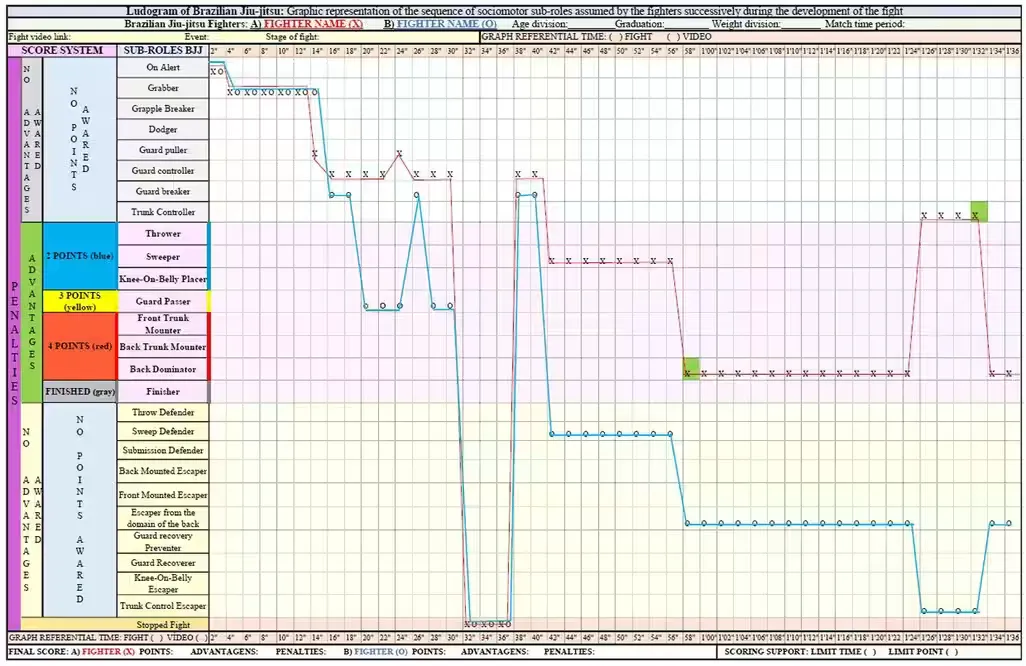
Research into Brazilian Jiu-Jitsu shows just how active this predictive loop becomes under live rolling conditions. A 2023 study introduced the concept of a “Ludogram”, a dynamic map of the sub-roles a grappler flows through during a match, like framing, advancing, or countering.
The authors argued that anticipation, pattern reading, and sociomotor intelligence are the core skills separating elite performance from average play (Schmidt & Ribas, 2023).
This predictive ability is what enables athletes to enter flow states during training, where movements feel automatic and timing becomes instinctive.
Guard Passing Through the Lens of Neuroscience
Anticipation vs Reaction
Reacting is already too late. The best passers operate ahead of the timeline. Their nervous systems are running simulations in the background. Every grip, frame, and breath is a clue that updates their forecast.
When athletes like Meregali or Dalpra pass with what looks like perfect timing, what’s really happening is neural modeling: their brains are predicting likely behaviors and preparing for them before the opponent commits.
Building Internal Models of Opponent Behavior
After enough mat time, the nervous system begins to store “if-then” patterns:
- If someone grips your collar with their right hand, they tend to rotate left.
- If the hips elevate, expect an open guard transition.
- If their foot floats off the mat, expect a knee shield or pendulum swing.
You don’t consciously memorize this. Your nervous system just logs the correlations and begins forecasting.
This neural modeling process is enhanced through nervous system training that teaches your body to recognize patterns under stress, not just in calm drilling scenarios.
How Repetition Builds Predictive Models
The Observation-Action Loop
Every guard pass you attempt strengthens a feedback circuit:
You observe, act, get feedback, and adjust. This creates a sensorimotor link between sensation and action, which is how prediction improves over time.
This isn’t just theory. In one study, researchers found that neuromuscular function explains over 70% of BJJ performance in high-intensity, tactical situations, especially in explosive transitions and passing actions. Their data showed that how well your brain and muscles coordinate directly predicts performance quality (Coswig et al., 2018).
This coordination between brain and body is what makes pressure passing psychology so effective. When your nervous system can predict and prepare, pressure becomes strategic rather than just physical.
Encoding Expectations Through Drills
Drilling guard passes isn’t just about muscle memory. You’re training your brain to recognize patterns in pressure, structure, and timing.
For example, drilling a knee-cut pass over and over encodes the expected opponent reactions: pressure leads to a frame, the hip shifts, and an underhook is likely. Each rep makes your prediction more precise.
A good application for this: use TapFlow to create timing rounds where you alternate 20 seconds of passing pressure with 10 seconds of “observation pause,” letting your brain predict before you move again. This rhythm mirrors real neural feedback cycles.
Flow States and Predictive Efficiency
Flow state is what happens when your internal model and reality line up so perfectly that there’s almost no surprise. The brain’s predictions match reality in real time, and everything starts to feel automatic.
Flow rolling is one of the fastest ways to enter this calibration zone. Because the intensity is lower, your nervous system can experiment and fine-tune without overload. Mistakes still happen, but they’re used as data, not defeats.
In that sense, flow rolling isn’t a soft roll. It’s neural tuning in disguise.
For a deeper dive into how flow states enhance BJJ performance, read our comprehensive guide on achieving flow states in BJJ through structured drills and training methods.
How to Train Anticipation in Guard Passing
Constraint-Based Drills
When you reduce the number of possible outcomes, your brain learns faster.
Try limiting a guard pass drill so you can only pass to one side, and your partner can only defend with one leg. The narrower the possibility space, the sharper your prediction becomes. Then, reintroduce complexity once the base patterns are mapped.
Sensory Attention
Elite passers don’t just read positions. They feel micro-signals. Shoulder tension, subtle hip loads, changes in breathing. All of these help the brain guess what’s next before the opponent commits.
Training your body to feel these early signs turns you into a better predictor, not just a faster mover.
The Role of Feedback and Prediction Error
Mistakes in passing aren’t just failures. They’re updates. Every time you fail to anticipate a movement, your nervous system gets new data to re-calibrate.
That’s why journaling or post-round reflection is so powerful. This practice is one of the key mental skills for BJJ athletes that accelerates learning and pattern recognition.
Try jotting one sentence after a pass attempt:
- “Missed the frame shift on left underhook.”
- “Expected knee shield but guard dropped instead.”
These mini-notes reinforce large-scale neural correction. TapFlow makes this easy by adding a quick reset segment where you can note observations between rounds.
Guard Passing Drills for Neural Precision
A few training formats to try:
- Reaction-Prediction-Execution: Start with 10 seconds of reactive defense, followed by 10 seconds of predictive passing, then go full for 10 seconds.
- Adaptive Circuits: Switch roles every 30 seconds to build both passing and prediction from the defender’s view.
- Sensory Ladder: Try passing with eyes closed for 5 seconds, then reopen. This heightens your reliance on tactile and positional cues.
Every one of these drills helps refine your internal model of guard behavior.
Common Training Mistakes
- Focusing only on speed, not pattern reading
- Repping moves without watching your partner’s reactions
- Training too predictably, with no novelty or randomness
Prediction thrives on curiosity and variety, not just grinding out more reps. The brain needs variability to grow its forecast map.
FAQs on Neuroscience and Guard Passing
Q: Can you really train your brain to predict in BJJ? Yes. Internal models are learned through exposure and feedback.
Q: Is flow rolling better than hard sparring for prediction? Both have value. Flow lets you update patterns; sparring tests if those patterns hold under pressure.
Q: How long does it take for prediction to feel automatic? Like most motor learning, it takes hundreds of quality reps. But you’ll feel the shift when you start acting early, not reacting late.
Conclusion: From Reaction to Prediction
Guard passing at the highest level isn’t about reacting quickly. It’s about not needing to react at all.
Your brain can learn to see what’s coming next. Through drills, feedback, and focused observation, it builds a simulation of guard behavior that runs just ahead of real time.
That’s the neural edge in BJJ. And with structured training tools, you can sharpen it on purpose, not just by chance.
The neuroscience of guard passing connects to broader training principles: nervous system resilience that keeps you calm under pressure, mental skills training that sharpens focus, and flow state optimization that makes prediction feel automatic.
Train your models. Read the patterns. And step ahead, before the fight begins.
That’s TapFlow.