

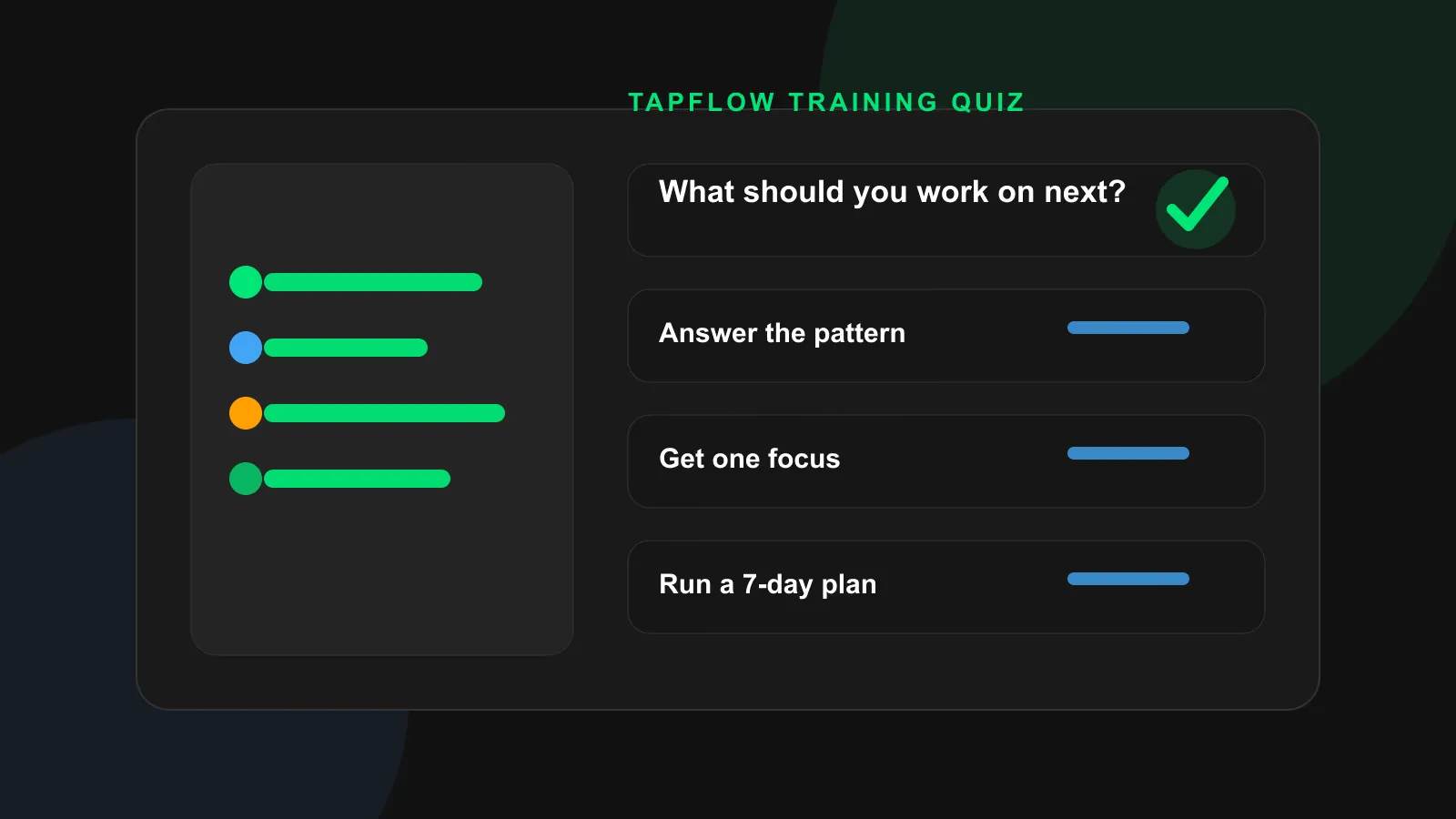
Take the BJJ training quiz
Most BJJ training advice is technically correct and still too broad.
You could work on guard retention, escapes, passing, takedowns, conditioning, submissions, grip fighting, back control, breathing, or your entire A-game. That list is not wrong. It is just hard to act on when you only have a few sessions this week.
This BJJ training quiz gives you one useful answer: what should you work on next?
The result is not a belt test or a diagnosis. It is a practical self-audit. Answer based on what actually happens in your rounds, then open the TapFlow 7-day focus plan for your result.
How the quiz chooses your focus
The quiz looks for the training problem that appears most often in your answers. If your rounds keep falling apart when your guard is half-passed, your result will point toward guard retention. If you know the technique but panic under pressure, your result will point toward calm under pressure.
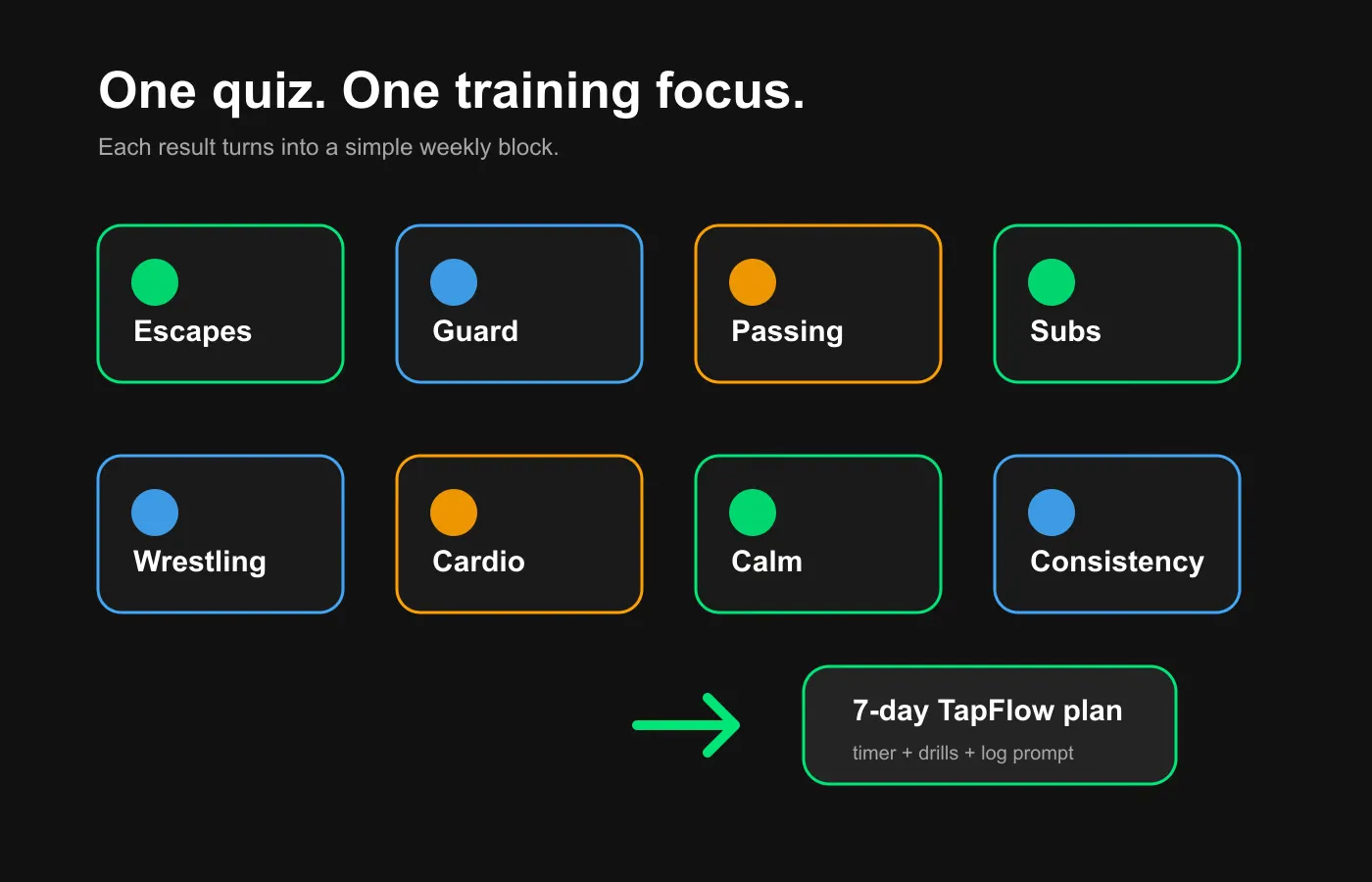
The goal is not to label your whole game. It is to pick the next block that gives you the cleanest return on training time.
What you get after the quiz
Each result gives you:
- one focus area
- why that focus matters
- a simple timed training block
- one metric to watch
- a branded TapFlow printable worksheet
- a suggestion for how to structure the timer in TapFlow
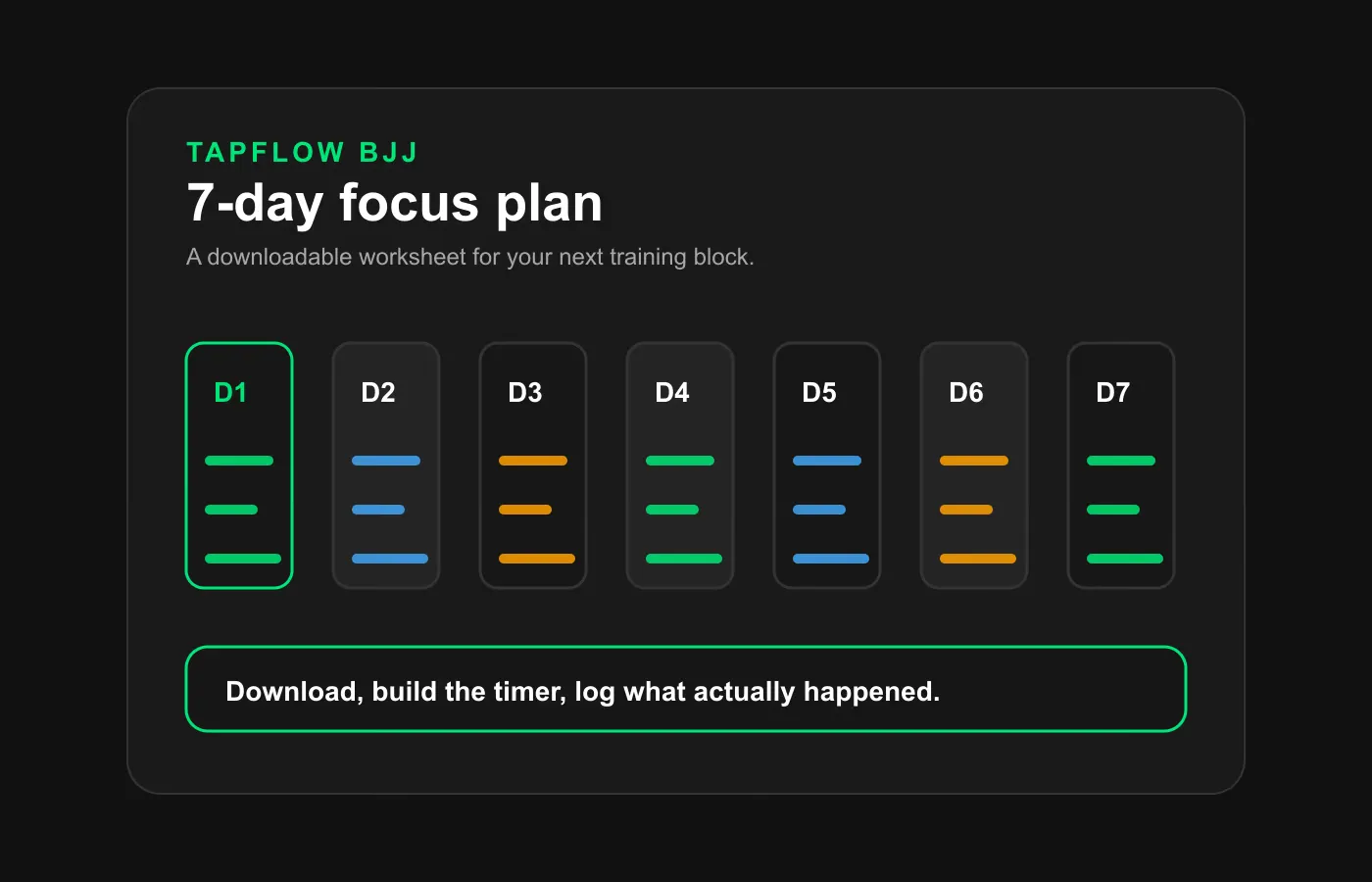
You can use the printable plan without TapFlow. But if you already use the app, the plan becomes easier to repeat: build the timer once, run the same block for a week, and log what happened after training.
The eight possible results
Guard retention
For grapplers who get passed before their frames, hips, and knee line are ready. The plan focuses on recovering guard before the pass settles.
Escapes
For grapplers who spend too much energy under mount, side control, or back control. The plan focuses on first frames, hip angle, and calm exits.
Guard passing
For grapplers who react to every guard shape instead of running one passing plan. The plan narrows your work to one entry, one reaction, and one finish.
Submission finishing
For grapplers who reach good positions but lose control near the finish. The plan focuses on control before the tap.
Takedowns and wrestling up
For grapplers who hesitate before contact or struggle to turn bottom positions into top control. The plan focuses on clean entries and control.
BJJ conditioning
For grapplers whose technique fades when the round gets hard. The plan uses grappling-specific intervals instead of random cardio.
Calm under pressure
For grapplers who know the answer but rush when pressure hits. The plan focuses on breathing, pacing, and one useful cue at a time.
Training consistency
For grapplers who need a clearer weekly rhythm. The plan focuses on showing up with intent and logging the same simple block.
How to use your 7-day plan
Do not turn the result into a personality type. Treat it like a training block.
Run the suggested rounds for one week. Keep the same timer structure. After each session, write one short note about what happened. If the problem improves, move to the next focus. If it still shows up in rounds, repeat the same block for another week.
For more structure, pair this quiz with the BJJ drills and conditioning pillar or the BJJ training timer and class structure guide. If your result is calm under pressure, the BJJ nervous system training article is a good next read.
Why TapFlow fits this kind of training
TapFlow is useful here because the plan depends on repeatable structure.
You can build custom timer segments, save rounds, run work and rest intervals, favorite useful timers, connect training to drills and moves, and log sessions manually or after completed timers. Over time, the heatmap and training totals help you see whether the plan became a real habit or stayed as a good idea.
That is the whole point: less guessing, more useful rounds.